External load
The work itself: the weight on the bar, the miles, the watts. The same 5-mile run is the same distance whether you're fresh or exhausted.
Strain, explained
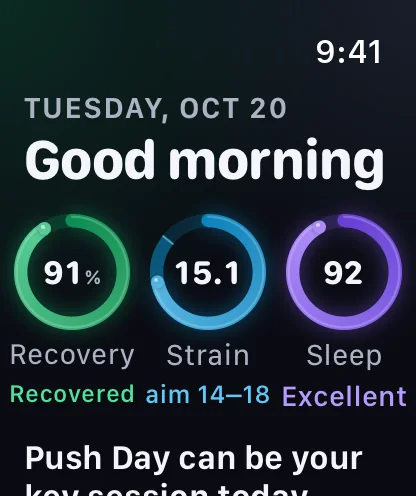
How much load your body took on in a day: your workouts, measured by heart rate or by how hard they felt, plus everyday activity. Fullday shows it from 0 to 21, on a scale that gets harder to climb near the top, beside an aim for the day set by your recovery.
The Strain score is free with Apple Health · Pro adds today's aim and the coaching

Sports scientists split training load in two: what you did, and what it cost your body. Impellizzeri 2019.
The work itself: the weight on the bar, the miles, the watts. The same 5-mile run is the same distance whether you're fresh or exhausted.
Your body's response: how high your heart rate went, for how long, and how hard it felt. That's what strain measures, so a tough run on a hot day counts for more.
How hard a session felt, times its minutes, tracks a heart-rate measure closely across cycling, intervals and basketball. Foster 2001.
How Fullday counts it
Each workout adds its load in the best way the app has, and the screen tells you which it used.
Minutes in each of five heart-rate zones, times the zone: an hour in zone 4 counts far more than an hour in zone 1. Edwards 1993. Your zones
No heart rate? How hard it felt, from 1 to 10, times its minutes. Foster 2001.
Active calories outside your workouts, from Apple Health: a busy day on your feet counts too.
Your maximum heart rate comes from your age (208 − 0.7 × age, Tanaka 2001) or the highest you've reached; with a resting heart rate, the zones use your heart-rate reserve.

The day's load is squeezed onto 0 to 21, so each extra point near the top takes more work than the last.
Rest days, walks, mobility, an easy session.
Your usual session at a controlled effort.
Heavy lifts, a long or hard session.
Rare: doubling a day's load that scores about 13 only takes it to about 18.
The curve: strain = 21 × (1 − e−load ÷ 400), where a workout's load is its zone-weighted heart-rate minutes × 3, or effort × minutes, and everyday activity adds active calories ÷ 3.
On the Strain screen
Strain is only useful if you can see what built it, so the screen shows its working.
Today's strain on its ring and the last seven days as bars. With Pro, today's aim sits across them, with how far you are from it.
Each workout and your everyday activity, with the points it added and how it was measured: from heart rate, from your effort rating, or estimated until you rate it.
Strain is one day's load. Fitness builds over weeks of load and rest, which Pro charts as fitness, fatigue and form.
Training hard when your morning HRV held up, and easy when it dropped, improved running fitness more than a fixed plan in one 4-week study of 26 men. Kiviniemi 2007.
Recovered · 67 and up
14–18
Heavy lifts or a hard session fit today.
Steady · 34 to 66
10–14
Your usual session, at a controlled effort.
Take it easy (under 34): keep strain under 10. Rest Mode on: under 8. The first two days back from Rest Mode aim one zone lower. Today's aim and the coaching are Pro, as is a fitness, fatigue and form chart over all your training. How Recovery is worked out
There isn't one number. A good strain is one that matches how ready you are: in Fullday, 14 to 18 on a recovered day, 10 to 14 on a steady one and under 10 when it's time to take it easy. Easy days are part of training.
The scale bends near the top on purpose. Doubling a day's load that scores about 13 only takes it to about 18, so 21 is out of reach on almost any day.
Yes. A lifting session logged in Fullday counts from the heart rate your watch recorded during it, or from how hard it felt times its minutes. Strength on Apple Watch
Not as steps. Everyday movement counts through the active calories Apple Health records outside your workouts.
Not on its own; hard days are how you get fitter. What matters is balancing them with recovery. Fullday is for general wellness and doesn't give medical advice: if you feel unwell, dizzy or have chest pain during exercise, stop and talk to a doctor.
Next: recovery on Apple Watch, or what is a good HRV?
Impellizzeri FM, Marcora SM, Coutts AJ (2019). Internal and external training load: 15 years on. International Journal of Sports Physiology and Performance, 14(2), 270–273. doi.org/10.1123/ijspp.2018-0935
Foster C, Florhaug JA, Franklin J, et al. (2001). A new approach to monitoring exercise training. Journal of Strength and Conditioning Research, 15(1), 109–115. pubmed.ncbi.nlm.nih.gov/11708692
Edwards S (1993). The Heart Rate Monitor Book. Polar Electro. openlibrary.org
Tanaka H, Monahan KD, Seals DR (2001). Age-predicted maximal heart rate revisited. Journal of the American College of Cardiology, 37(1), 153–156. doi.org/10.1016/S0735-1097(00)01054-8
Kiviniemi AM, Hautala AJ, Kinnunen H, Tulppo MP (2007). Endurance training guided individually by daily heart rate variability measurements. European Journal of Applied Physiology, 101(6), 743–751. doi.org/10.1007/s00421-007-0552-2

Coming to the App Store this December. Recovery, Strain and Sleep scores are free with Apple Health.
Pre-orders open soon.
Email us for a note when they open