Deep sleep is the worst time
Woken suddenly from deep, slow-wave sleep, people feel and perform worse than when woken from lighter sleep; REM sits in between. Tassi & Muzet 2000.
Sleep, explained
An alarm that wakes you inside a window before your set time, at a moment you seem to be sleeping lightly, instead of on the dot. The idea comes from sleep research: waking from deep sleep leaves you groggier. Whether a wrist can time it well enough to make mornings better hasn't been tested much.
Smart wake on Apple Watch is free · your iPhone alarm stays as the backup

That heavy, slow feeling just after you wake has a name: sleep inertia.
Woken suddenly from deep, slow-wave sleep, people feel and perform worse than when woken from lighter sleep; REM sits in between. Tassi & Muzet 2000.
Studies have measured sleep inertia lasting from a minute to a few hours, but without serious sleep loss it rarely lasts beyond 30 minutes. Tassi & Muzet 2000.
Losing sleep tends to add deep sleep to the night, so after a short night you're more likely to be woken from it. Tassi & Muzet 2000.
What the evidence says
We looked for trials of smart alarms that time the wake-up to your sleep from a watch, and found none. So here is what is known, and what isn't.
Which stage you wake from changes how groggy you feel at first.
A wrist can tell asleep from awake well, but stages less well. In Apple's own lab test the commonest slip was deep sleep read as Core. Wrist movement is not as accurate as a sleep lab. Ancoli-Israel 2003.
Whether waking a few minutes early, in a lighter-looking moment, leaves you feeling better through the day.
Enough sleep, at regular times. No alarm makes up for a short night. How much sleep you need
So treat a smart alarm as a gentler way to wake, not a fix for tiredness.

On Apple Watch, for any alarm you set in Fullday on your iPhone. Free, with nothing to sign in to.
15 or 30 minutes before your alarm, in the alarm's settings on your iPhone. The window always ends at your alarm, never later. 30 minutes is the longest Apple lets a watch app run a smart alarm.
The first two minutes of the window set how still you're lying tonight. Then the watch checks your wrist every 30 seconds, and your heart rate when it has a reading.
When your wrist moves well above tonight's stillness, or your heart rate rises with some movement, the watch taps you gently, then firmer. If you never stir, it taps just before your alarm.
Your iPhone alarm at the end of the window is the backup. Tap I'm Up and it's turned off too; tap Stop and it still rings.
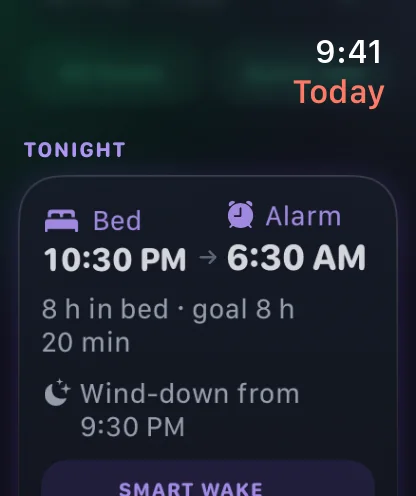
On the watch, tonight's window and "Set · taps you when you stir", with how it works one tap away.
Inside the window the watch follows your wrist, and says so if you glance at it.
The taps start and the watch shows I'm Up and Stop. I'm Up also ends the night's sleep timer and scores last night a few minutes later, once the watch has saved your stages.
Turn it on for an alarm in Fullday on your iPhone, under Sleep and your schedule.
Open Fullday on your watch in the evening so it can set tonight's session: Apple lets a watch app schedule one only while it's open, up to 36 hours ahead. Wear the watch to bed with enough charge for the night.
The idea is sound: waking from deep sleep leaves you groggier (Tassi & Muzet 2000). We found no trials showing a watch-timed alarm makes you feel better through the day, and wrists estimate stages imperfectly. Think of it as a gentler way to wake.
Long enough to catch a lighter moment, short enough that you don't lose much sleep. Fullday offers 15 or 30 minutes; 30 is the longest a watch app can run one.
Your iPhone alarm still rings at the time you set, as the backup. Tapping I'm Up on the watch turns that alarm off for the morning; tapping Stop leaves it on.
Yes. Fullday's smart wake runs on Apple Watch, which reads your wrist through the window. Without a watch, Fullday's alarm rings on your iPhone at the time you set.
It won't fix it. Enough sleep at regular times matters far more. If you feel sleepy most days despite enough time in bed, or you snore loudly, talk to a doctor. Fullday is for general wellness, not a medical device.
Next: what are sleep stages? Or see everything for the night on the Sleep page.
Tassi P, Muzet A (2000). Sleep inertia. Sleep Medicine Reviews, 4(4), 341–353. doi.org/10.1053/smrv.2000.0098
Ancoli-Israel S, Cole R, Alessi C, Chambers M, Moorcroft W, Pollak CP (2003). The role of actigraphy in the study of sleep and circadian rhythms. Sleep, 26(3), 342–392. doi.org/10.1093/sleep/26.3.342
Apple (updated October 2025). Estimating Sleep Stages from Apple Watch. apple.com/health
Apple. Using extended runtime sessions, WatchKit documentation. developer.apple.com

Coming to the App Store this December. Smart wake on Apple Watch and the sleep score are free.
Pre-orders open soon.
Email us for a note when they open