Not a metronome
At 60 beats a minute, the gaps between beats aren't all exactly one second. Some are a little longer, some a little shorter. HRV measures that spread, in milliseconds.
HRV, explained
One that's at or above your own normal. HRV falls with age and differs widely between people: in a study of 1,906 healthy adults, average SDNN was about 49 to 50 ms at ages 25 to 34 and 28 to 30 ms at 65 to 74. So the useful question is how last night compares with your own normal.
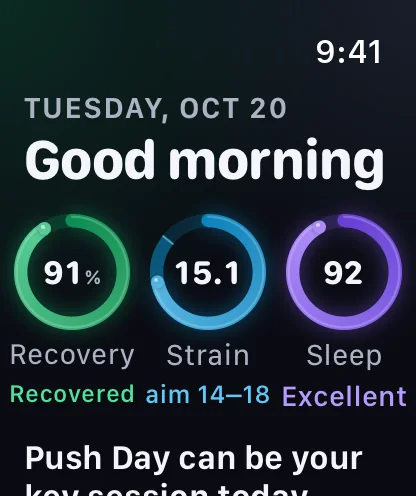
Recovery, Strain and Sleep scores are free with Apple Health · Pro adds the coaching on them

Heart rate variability is how much the time between your heartbeats changes from one beat to the next.
At 60 beats a minute, the gaps between beats aren't all exactly one second. Some are a little longer, some a little shorter. HRV measures that spread, in milliseconds.
The rest-and-digest side of your nervous system varies the gaps. Rested, HRV tends to sit higher; when your body is busy with stress, illness or hard training, it tends to drop.
One night says little. Read against your own normal over weeks, HRV is a useful sign of how you're absorbing training. Plews 2013.
Both are in milliseconds, but they're worked out differently, so never compare one with the other.
The standard deviation of the gaps between normal beats. It's the HRV Apple Watch has always saved to Apple Health: Apple's developer documentation says HealthKit, the store behind the Health app, uses SDNN.
Built from the differences between neighbouring beats, it mostly reflects the rest-and-digest system. Sports research on daily HRV often reads it (Plews 2013). iOS 27 adds an RMSSD type to Apple Health.
A 24-hour recording, five minutes and a few seconds each give different values for the same person. They aren't interchangeable either. Shaffer & Ginsberg 2017.
Apple Watch Series 12 and Ultra 4 also show a Recovery HRV in the Heart Rate app. Whichever number you follow, compare it only with itself.
Five-minute ECG readings, lying down, from 1,906 healthy adults in a population study in the Augsburg region of Germany. Voss et al. 2015.
| Age | SDNN, women | SDNN, men | RMSSD, women | RMSSD, men |
|---|---|---|---|---|
| 25–34 | 49 ± 19 ms | 50 ± 21 ms | 43 ± 23 ms | 40 ± 20 ms |
| 35–44 | 45 ± 21 ms | 45 ± 17 ms | 35 ± 19 ms | 32 ± 17 ms |
| 45–54 | 37 ± 14 ms | 37 ± 15 ms | 26 ± 14 ms | 23 ± 11 ms |
| 55–64 | 31 ± 12 ms | 33 ± 15 ms | 21 ± 12 ms | 20 ± 11 ms |
| 65–74 | 28 ± 12 ms | 30 ± 13 ms | 19 ± 12 ms | 19 ± 11 ms |
Average ± one standard deviation, rounded to the millisecond. The spread is wide, so plenty of healthy people sit well above or below the average. A pooled review of 44 studies and 21,438 healthy adults found similar short-term averages: SDNN about 50 ms, RMSSD about 42 ms (Nunan et al. 2010). Your watch reads HRV optically whenever you're still, not lying in a lab for five minutes, so its numbers won't line up exactly. Use the table for the shape of the curve, not as a target.
Your own normal
Two healthy people of the same age can be 20 ms apart and both be fine. What tells you something is a change against your own usual.
A short night can pull HRV down the next morning. How sleep is scored
In 4,098 adults, drinking lowered HRV-based recovery in the first hours of sleep, more the more they drank, and even after a little. Pietilä 2018.
Getting ill can pull HRV below your normal.
A hard block pulls it down; bouncing back above your normal is a good sign you absorbed the work. Plews 2013.
A stressful stretch shows up in HRV too.
With Pro, the coaching tells you when HRV has sat below your normal three days running, and what usually helps.


Apple Watch records HRV on its own. Wear it to bed for the overnight readings.
On iPhone, Heart Rate Variability is under Heart, with every reading your watch has saved, as SDNN.
Apple Watch Series 12 and Ultra 4 show a Recovery HRV in the Heart Rate app, sampled while you're still.
Last night's HRV on the Recovery screen, against your normal, with how far above or below it you are. The watch app
How Fullday uses it
Fullday reads the HRV your Apple Watch saves to Apple Health, with nothing to sign in to, and only ever compares SDNN with your own SDNN.
The readings from 8 pm to 10 am are averaged into one number for the morning, and it counts for the most in Recovery. Plews 2013 · HRV trends.
Set against the 30 days before: your own last month, not an average of other people.
With resting heart rate and last night's sleep score, it makes Recovery, from 1 to 99. How Recovery is worked out
With less than a week of overnight heart data, the app says it's still learning your normal.

Not on its own. It depends on your age, the measure and your own normal. In Voss 2015, average five-minute SDNN was about 31 to 33 ms at 55 to 64, and plenty of healthy people sat well below the average. A drop from your usual says more than the number itself.
Cut-offs like that come from 24-hour ECG recordings used to judge heart risk. A 24-hour SDNN is usually a much larger number than a short reading, and the two aren't interchangeable (Shaffer & Ginsberg 2017), so it doesn't apply to your watch's readings.
Hardly, in short readings. In Voss 2015, women's and men's SDNN and RMSSD didn't differ significantly in any age group. Age made a much bigger difference.
Better aerobic fitness goes with higher HRV (Shaffer & Ginsberg 2017). Day to day, the things that pull it down are the ones to watch: short sleep, alcohol, illness, stress and hard training without enough rest.
HRV alone doesn't diagnose anything, and Fullday is for general wellness, not a medical device. If you're worried, or you feel unwell, dizzy, faint or have chest pain, talk to a doctor.
Next: what is a good resting heart rate? Or work out your heart-rate zones.
Voss A, Schroeder R, Heitmann A, Peters A, Perz S (2015). Short-term heart rate variability: influence of gender and age in healthy subjects. PLoS ONE, 10(3), e0118308. doi.org/10.1371/journal.pone.0118308
Shaffer F, Ginsberg JP (2017). An overview of heart rate variability metrics and norms. Frontiers in Public Health, 5, 258. doi.org/10.3389/fpubh.2017.00258
Nunan D, Sandercock GR, Brodie DA (2010). A quantitative systematic review of normal values for short-term heart rate variability in healthy adults. Pacing and Clinical Electrophysiology, 33(11), 1407–1417. doi.org/10.1111/j.1540-8159.2010.02841.x
Plews DJ, Laursen PB, Stanley J, Kilding AE, Buchheit M (2013). Training adaptation and heart rate variability in elite endurance athletes: opening the door to effective monitoring. Sports Medicine, 43(9), 773–781. doi.org/10.1007/s40279-013-0071-8
Pietilä J, Helander E, Korhonen I, Myllymäki T, Kujala UM, Lindholm H (2018). Acute effect of alcohol intake on cardiovascular autonomic regulation during the first hours of sleep in a large real-world sample of Finnish employees. JMIR Mental Health, 5(1), e23. doi.org/10.2196/mental.9519
Apple. heartRateVariabilitySDNN and heartRateVariabilityRMSSD, HealthKit documentation; Monitor your heart rate with Apple Watch, Apple Support. support.apple.com/en-us/120277

Coming to the App Store this December. Recovery, Strain and Sleep scores are free with Apple Health.
Pre-orders open soon.
Email us for a note when they open