When to check
In the morning after a good night's sleep, before you get out of bed or have that first coffee.
Resting heart rate, explained
For most adults, 60 to 100 beats a minute when sitting or lying calmly, says the American Heart Association, and athletes can rest as low as 40. Lower usually means a fitter heart. Within that range, the number to watch is your own normal, and any change from it.
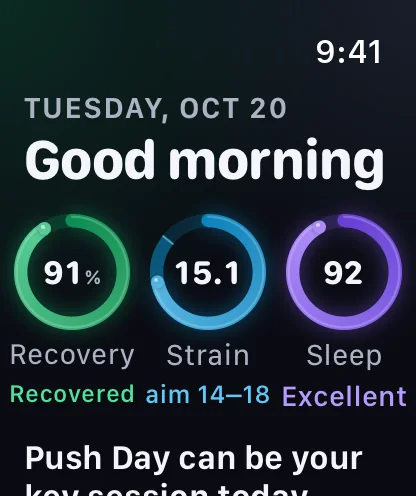
Recovery, Strain and Sleep scores are free with Apple Health · No account

Your resting heart rate is how many times your heart beats in a minute when you're still, calm and well.
In the morning after a good night's sleep, before you get out of bed or have that first coffee.
Two fingertips lightly on the inside of your wrist, thumb side. Count the beats for 30 seconds and double it.
A lower resting rate usually means the heart muscle is in better condition and doesn't have to work as hard.
All three from the American Heart Association. A rate under 60 doesn't always signal a problem: it's common in athletes, lower during sleep, and some medicines, such as beta blockers, slow it.
In adults, the average barely moves with age. Seated pulse counts from 35,302 people in the US national health survey, 1999–2008. Ostchega et al. 2011.
| Age | Men, average | Men, middle half | Women, average | Women, middle half |
|---|---|---|---|---|
| 16–19 | 72 bpm | 61–78 | 79 bpm | 69–85 |
| 20–39 | 71 bpm | 61–76 | 76 bpm | 66–82 |
| 40–59 | 71 bpm | 61–77 | 73 bpm | 64–79 |
| 60–79 | 70 bpm | 60–75 | 73 bpm | 64–78 |
| 80 and over | 71 bpm | 61–78 | 73 bpm | 64–77 |
People with a condition or medicine that affects the pulse were left out. Half of people sat inside the middle-half band. Children's rates run higher: about 96 at ages 4 to 5 and 78 at 12 to 15. The pulse was counted by hand after about four minutes of sitting quietly, a different method from a watch's estimate of your lowest rate at rest, so expect your watch to read differently.
Your own normal
In 92,457 adults wearing a wrist tracker, one person's normal resting rate could differ from another's by as much as 70 bpm. Within a person, it stayed far more consistent. Quer et al. 2020.
Fitness, being asleep, and medicines such as beta blockers and calcium channel blockers.
Heat or a raised body temperature, stress, anxiety, pain, illness, dehydration, alcohol and a hard block of training. Buchheit 2014.
It can rise a little when you first stand, and settles within a few minutes.
In the same study, resting rates were lowest in July and highest in January, and one person in five had at least one week where theirs moved by 10 bpm or more.
Heat, emotions, standing and medicines: the American Heart Association; illness, dehydration and alcohol: the app's coaching. With Pro, a morning 3 bpm or more above your normal gets a note on what can raise it, and when to talk to a doctor.


Your heart rate is one clue to your health, not a verdict. These are the American Heart Association's pointers.
If your heart rate has been slower or faster than usual for you, especially if you've felt weak, dizzy or like you might faint. A resting rate over 100 may be tachycardia and under 60 may be bradycardia, though neither is always a problem.
If your heart rate is suddenly very high or very low for you, especially with chest pain, shortness of breath, dizziness or fainting. Outside the US, call your local emergency number.
Beta blockers and some other medicines slow your heart rate on purpose. If you take one, ask your healthcare professional what your rate should be, and when and how often to check it.
Fullday is for general wellness, not a medical device: its scores never diagnose anything.
No counting needed: your watch works it out from the day's readings.
Apple Watch estimates your lowest heart rate at rest from the readings it takes while you sit still through the day, and may refine the day's figure as more come in.
In the Heart Rate app on the watch, and under Heart in the Health app on iPhone. Heart rate notifications can tell you when your rate stays above or below a number you choose.
Each day's resting rate against your normal from the 30 days before. Below it counts in your favour in Recovery; above it counts against you. How Recovery is worked out
Fullday also shows last night's HRV, resting heart rate, breathing rate, wrist temperature and blood oxygen as body signals, each against your own normal. Two outside it reads as a sign of strain, never a diagnosis. Free, with no account. The watch app
For many active people, yes: the American Heart Association says athletes can rest as low as 40 and that a lower rate usually means a heart in better condition. If a low rate is new for you, or comes with dizziness, weakness or fainting, talk to a doctor.
They measure different things. Apple Watch estimates your lowest rate at rest across the day; a clinic counts your pulse once while you sit. In the US survey, seated adults averaged 72 bpm, while daily resting rates from a large wrist-tracker study averaged 65 bpm.
It falls through childhood, then barely moves. Men averaged 70 to 71 bpm in every adult age group in the US survey; women averaged 76 at 20 to 39 and 73 from 40 on.
For most people, not much. In Quer 2020 it stayed fairly steady within a person, though one in five had at least one week where it moved by 10 bpm or more. Illness, dehydration, alcohol, heat or hard training can raise it for a while. If it stays up for days, or comes with chest pain, dizziness or feeling unwell, talk to a doctor.
No. Fullday is not a medical device and doesn't diagnose anything. Its scores and tips are for general wellness, and every tip names the study or guideline behind it. Talk to a doctor about any health concern.
Next: what is a good HRV? Or use your resting rate to work out your heart-rate zones, and see how sleep is scored.
American Heart Association. All about heart rate. Last reviewed 13 May 2024. heart.org
American Heart Association. Target heart rates chart. Last reviewed 12 August 2024. heart.org
Ostchega Y, Porter KS, Hughes J, Dillon CF, Nwankwo T (2011). Resting pulse rate reference data for children, adolescents, and adults: United States, 1999–2008. National Health Statistics Reports, no. 41. National Center for Health Statistics. cdc.gov
Quer G, Gouda P, Galarnyk M, Topol EJ, Steinhubl SR (2020). Inter- and intraindividual variability in daily resting heart rate and its associations with age, sex, sleep, BMI, and time of year: retrospective, longitudinal cohort study of 92,457 adults. PLoS ONE, 15(2), e0227709. doi.org/10.1371/journal.pone.0227709
Buchheit M (2014). Monitoring training status with HR measures: do all roads lead to Rome? Frontiers in Physiology, 5, 73. doi.org/10.3389/fphys.2014.00073
Apple. restingHeartRate, HealthKit documentation; Monitor your heart rate with Apple Watch, Apple Support. support.apple.com/en-us/120277

Coming to the App Store this December. Recovery, Strain and Sleep scores are free with Apple Health.
Pre-orders open soon.
Email us for a note when they open